
The Role of Expert Witnesses in Criminal Defence Solicitor Cases

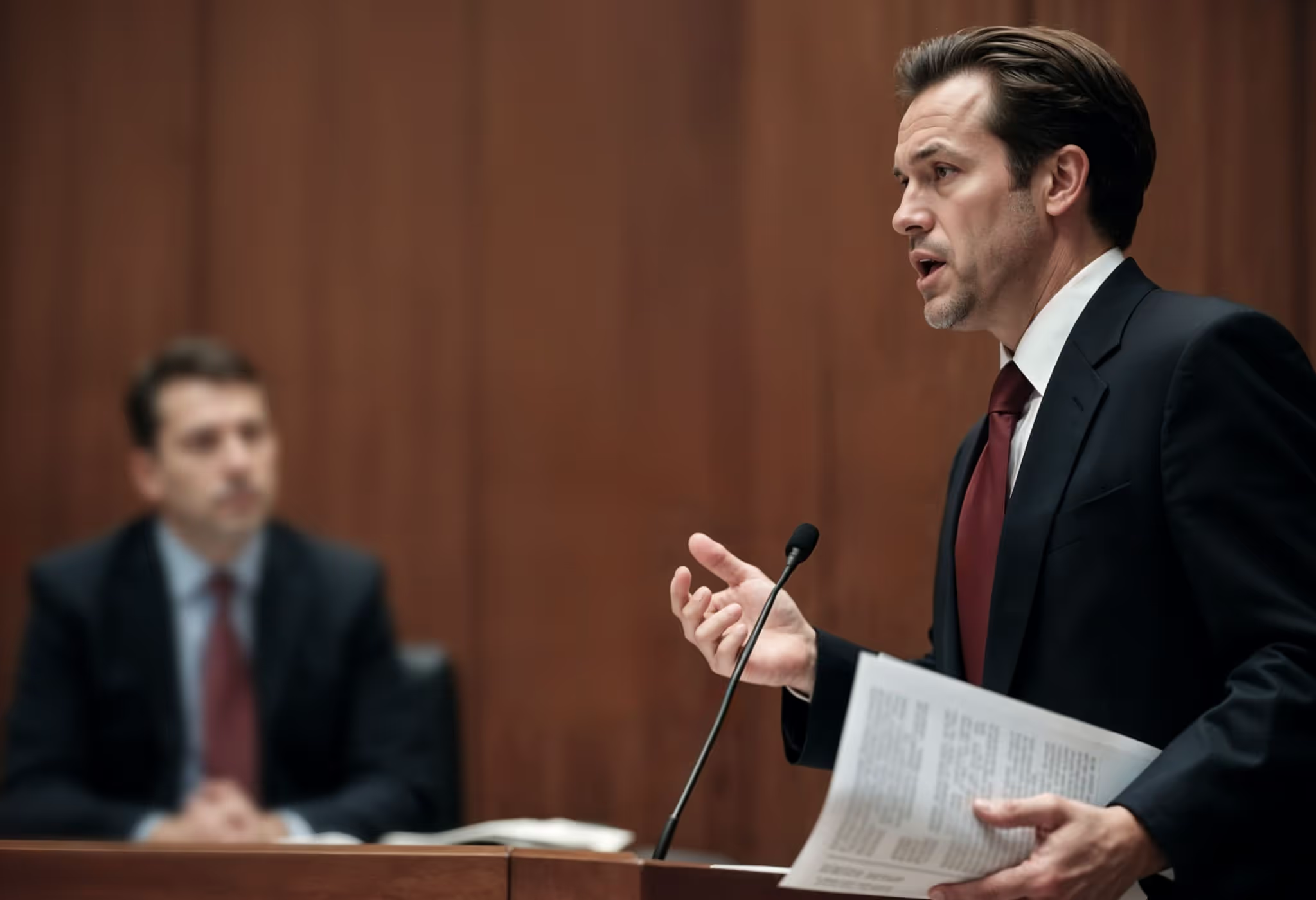
When a criminal case turns on evidence, opinions matter. Not opinions in the everyday sense, but expert opinions that can withstand scrutiny in a police interview room, a Crown Court, and under cross-examination.
We see it often. A case looks settled on paper. The prosecution has a report. It sounds technical. It carries weight. And yet, once properly tested, it starts to unravel.
That is where the role of expert witnesses in criminal defence solicitor UK cases becomes decisive. Not as an add-on, not as theatre, but as a core part of how a defence is built, challenged, and often, won.
At Holborn Adams, we approach expert evidence with a simple mindset: if it can influence a charging decision, a bail outcome, or a verdict, it deserves close attention early. Waiting until trial is usually too late.
Understanding the Role of Expert Witnesses in Criminal Defence Cases in the UK?
Anyone with exclusive and in-depth knowledge is an expert witness. In criminal defence, that expertise might encompass forensic science, digital analysis, medicine, psychology, accounting, cell site analysis, or handwriting analysis.
Under Criminal Procedure Rules Part 19, expert evidence must be objective, reasoned, and confined to the expert’s field. The expert works for the court, not the person who hired them. Judges take that duty seriously. So do we.
In practice, expert witnesses help answer questions like:
- Does this forensic result actually support the prosecution’s theory?
- Is the digital evidence complete, reliable, and lawfully obtained?
- Are there alternative explanations that have not been explored?
- Has the science been overstated?
Those questions can change the direction of a case long before a jury ever hears it.

When Should a Criminal Defence Solicitor Instruct an Expert Witness?
Earlier than most people expect.
By the time a case reaches trial, positions have hardened. Reports have been served. Timetables are tight. Damage control replaces strategy.
We often instruct experts during the investigation stage, sometimes before charge. There are good reasons for this.
Under the Police and Criminal Evidence Act 1984 (PACE), investigative decisions are made quickly. Phones are seized. Samples are taken. Statements are formed around early interpretations of evidence. If those interpretations go unchallenged, they tend to stick.
An early expert review can:
- Figure out where the prosecution's plan is weak
- Prevent flawed evidence from going unchallenged
- Support representations to the Crown Prosecution Service (CPS) before charge
- Shape interview strategy and disclosure requests
This is not about overcomplicating matters. It is about knowing when silence is sensible and when technical input is essential.
How Do Expert Witnesses Influence Charging Decisions?
Charging decisions are not made in a vacuum. Prosecutors rely heavily on summaries of evidence, particularly expert reports. If those reports are incomplete, one-sided, or wrong, the risk of charge increases.
We have seen cases where a single expert opinion has shifted the CPS position entirely. A digital download that looked damning until an independent analyst highlighted missing metadata. A medical opinion that assumed timing, which could not be supported. A financial calculation that ignored alternative explanations.
When expert input is introduced early, it can be woven into representations under the Code for Crown Prosecutors, particularly on evidential sufficiency and public interest.
That is often where cases are won quietly.
What Types of Expert Witnesses are Used in Criminal Defence?
The range is broad and growing.
Some of the most common expert disciplines we work with include:
- Digital forensics: mobile phones, computers, cloud data, encryption issues
- Forensic science: DNA, fingerprints, trace evidence, contamination risks
- Medical experts: causation, injury timing, mental health
- Psychological experts: fitness to plead, suggestibility, false confession risk
- Financial and accounting experts: fraud analysis, transaction tracing
- Cell site and telecommunications experts: location data and coverage limits
Each discipline has its own pitfalls. A report that looks convincing can fall apart if the underlying assumptions are flawed. Our role is to spot that early and act on it.
Are Expert Witnesses Used Only at Trial?
No. And that is a common misunderstanding.
Expert evidence plays a role throughout a case. It provides advice in police interviews, shapes bail applications, and underpins legal arguments about admissibility and fairness. It can even influence sentencing.
At trial, expert witnesses are subject to strict controls. Courts are alert to speculative conclusions. Experts must explain their reasoning clearly and withstand challenges.
We prepare cases with that reality in mind. An expert report that cannot survive cross-examination is worse than no report at all.
How Does the Court Assess Expert Evidence?
Judges look for clarity, independence, and logic.
Under Criminal Practice Directions, expert evidence must be necessary, relevant, and proportionate. The court will ask whether the issue genuinely requires expert input or whether it strays into matters the jury can decide themselves.
This is where experience matters. Knowing when expert evidence will help and when it will distract is part of effective defence work.
We have seen cases weakened by poorly chosen experts and unfocused reports. We avoid that trap by being precise about what the expert is asked to address and why.
Can Expert Witnesses Challenge Police and Prosecution Experts?
Yes. And often they must.
Prosecution expert evidence is not infallible. Laboratories make errors. Analysts work under time pressure. Context gets lost.
Challenging that evidence does not mean attacking the expert personally. It means testing methodology, assumptions, data integrity, and conclusions.
This is where the role of expert witnesses in criminal defence solicitor UK practice becomes critical. A calm, well-reasoned alternative opinion can expose doubt without theatrics.
Jurors understand uncertainty when it is explained properly.
What Happens if Experts Disagree?
Disagreement is not a failure. It is often the point.
Courts are used to seeing competing expert opinions. In some cases, experts meet in a joint conference to narrow issues. In others, disagreement is left for the jury to resolve.
Our job is to make sure disagreement is meaningful. That it turns on substance, not semantics and highlights reasonable doubt rather than confusing the issue.
We work closely with counsel to make expert evidence accessible without diluting its impact.
How Does Holborn Adams Approach Expert Evidence?
We treat expert evidence as part of the case theory, not a bolt-on.
That means:
- Identifying early whether expert input is needed
- Selecting experts with genuine court experience
- Giving clear, focused instructions
- Integrating expert findings into the wider defence narrative
We also manage expectations. Not every case benefits from expert evidence. Sometimes, restraint is the better tactic. The strength lies in judgment, not volume.
Over the years, we have seen how a single overlooked detail can carry disproportionate weight. That experience shapes how we work.
Is Expert Evidence Regulated in UK Criminal Cases?
Yes. And increasingly so.
Experts must comply with procedural rules, disclosure obligations, and ethical duties. Courts can exclude expert evidence that fails to meet required standards.
This protects defendants and the integrity of the process. It also means expert instruction must be handled carefully.
We stay close to procedural developments and judicial guidance because technical compliance often decides whether evidence is admitted at all.
Why Expert Witnesses Matter More Than Ever
Criminal cases are more technical than they used to be. Phones hold years of data. Financial trails cross borders. Scientific claims sound persuasive even when they are fragile.
Against that backdrop, the role of expert witnesses in criminal defence solicitor UK work is no longer niche. It is central.
The difference between assumption and proof matters, as does the difference between possibility and probability. Expert evidence helps courts see that difference clearly.
Working with an Expert Witness Criminal Defence Solicitor UK at Holborn Adams
We do not believe in noise. We believe in focus.
At Holborn Adams, we use expert evidence where it adds weight, clarity, and leverage. We challenge it where it overreaches and we explain it in plain terms so clients understand what is happening and why.
If expert opinion could affect the direction of your case, we will say so early. If it will not, we will be equally direct.
That honesty is deliberate.
If you are dealing with a case where the evidence feels technical, opaque, or stacked against you, speak to us. As a criminal defence solicitor at a UK firm, we leverage the role of expert witnesses to work with facts, not assumptions, and build defences that stand up when tested.
Holborn Adams is ready to step in when evidence matters most.

