
Public Order Defence Solicitor in the UK for Protest Cases

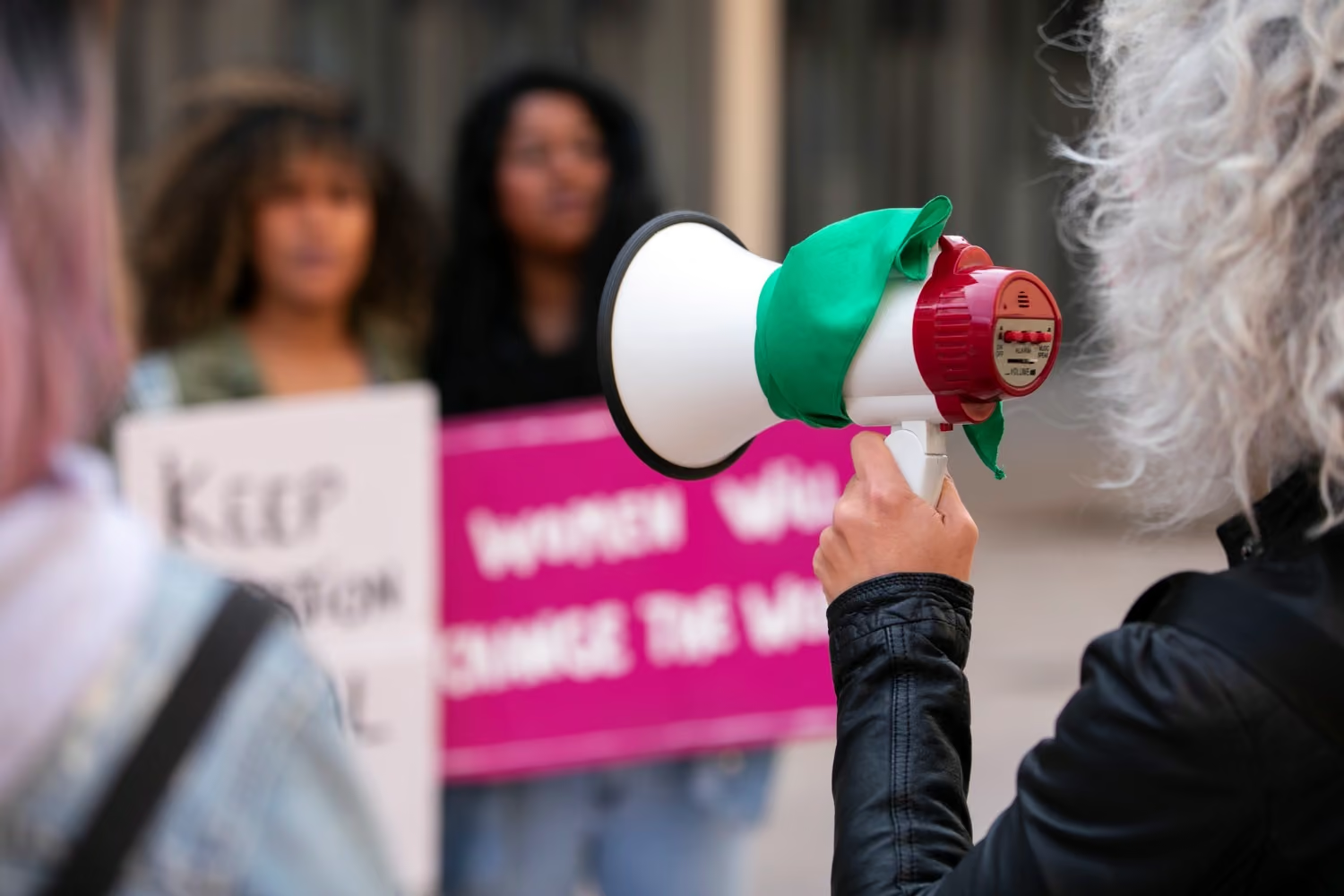
Public order and protest-related allegations can arise from a wide range of circumstances. Some involve large-scale demonstrations while others stem from a brief incident during a public gathering, political event, march, or assembly. Whatever the allegation, the consequences can extend far beyond the criminal courts. Your job, professional reputation, ability to travel, and the way people see you can all end up under the microscope.
Get the right advice early, and it often sets the course of the whole case. A public order defence solicitor in the UK can examine the evidence at an early stage, identify weaknesses in the prosecution’s case, and develop a strategy that reflects the facts rather than assumptions.
When it comes to public order offences, the Public Order Act 1986 does most of the heavy lifting. Depending on the allegation, prosecutors may also rely on legislation relating to protest activity, criminal damage, obstruction offences, or public nuisance. The prosecution still carries the burden of proving its case beyond a reasonable doubt. Every allegation must be tested against the available evidence, the legal framework, and the wider circumstances surrounding the incident.

When Should I Contact a Public Order Defence Solicitor in the UK?
The earliest stages of an investigation often present the most valuable opportunities to influence the course of proceedings.
Protest and public order investigations tend to draw on several strands of evidence at once. An arrest might happen at the scene, or you may be asked to attend a voluntary interview under caution. Alongside that, investigators will often work through:
- Body-worn camera footage
- CCTV
- Social media activity
- Witness statements
- Material from mobile phones and other digital devices
How these threads are handled in the early hours and days can shape the entire case. Securing legal representation from the outset means a defence approach can take form before investigators or prosecutors commit to key decisions, rather than after.
This is where early intervention matters, and we treat it as central at Holborn Adams. We scrutinise the disclosure, weigh up where the evidence is strong and where it is not, and, when the circumstances call for it, we engage with the investigation rather than waiting on the sidelines. Throughout, our priority stays the same: safeguarding our clients' interests at every stage.
What Happens During a Police Interview for a Public Order Offence?
A police interview is often one of the most decisive points in a criminal investigation. The words you use, and the way they are dealt with, can decide whether charges are brought, what evidence surfaces down the line, and where the case finally lands. That is why the groundwork matters: knowing what the evidence shows, thinking through the legal position, and thorough preparation all need to happen before the interview begins, not during it.
Which Public Order and Protest Offences Tend to Bring Charges?
Several offences regularly arise in protest-related investigations.
These include:
1. Riot: Section 1 of the Public Order Act 1986
2. Violent disorder under section 2
3. Affray under section 3
4. Fear or provocation of violence under section 4
5. Intentional harassment, alarm, or distress under section 4A
6. Harassment, alarm, or distress under section 5
7. Offences connected with public processions and assemblies
8. Public nuisance allegations
9. Criminal damage arising from protest activity
Every offence breaks down into particular legal elements, and it falls to the prosecution to prove each one. Riot allegations, for example, require evidence involving twelve or more individuals acting for a common purpose. Violent disorder involves a different legal threshold. More often than not, these distinctions sit right at the heart of how the defence is built.
Do Peaceful Protest Rights Provide a Defence?
The right to peaceful protest remains an important legal principle within the United Kingdom.
Courts frequently take account of the freedoms found in Articles 10 and 11 of the European Convention on Human Rights, which safeguard the right to speak your mind and the right to gather and protest. However, having those rights on your side does not settle a criminal case by itself; they form part of the picture rather than the whole of it. It can, however, form an important part of the wider legal analysis depending on the facts and allegations involved.
What Evidence Does a Public Order Defence Solicitor in the UK Examine?
Successful defence work often turns on evidence that receives limited attention during the initial stages of an investigation.
The evidence that matters in these cases can come from a wide range of sources, including:
- Police body-worn video
- CCTV recordings
- Footage filmed on mobile phones
- Live-stream recordings
- Social media posts
- Accounts from witnesses
- Location data showing where someone was
- Timelines of how events unfolded
- Material relating to how a protest was organised
Footage often paints a fuller picture than a witness’s recollection on its own. Who was where, at what moment, how the crowd moved, and how people interacted with police can all turn out to be important.
A public order defence solicitor in the UK will usually examine whether the available evidence supports the allegations being made. Context matters. A short video clip or selective account rarely presents the full picture.
Where there are grounds to do so, criminal defence solicitors can press for further disclosure or question whether the evidence the prosecution is relying on is reliable and whether it should be allowed to stand at all.
How Can a Defence Be Built Against Public Order Allegations?
No two cases call for the same response, so each has to be looked at on its own merits. Depending on the facts, a defence might rest on challenging whether someone has been correctly identified or on disputing a claim that violence was unlawful.
In other cases, it may turn on showing that a person was taking part in a protest lawfully, that their conduct was reasonable, or that they never held the intent the prosecution alleges. Inconsistencies between witness accounts can be drawn out, failures in how the process was followed can be examined, and evidence obtained unfairly can be challenged so that it is kept out altogether.
Intent often sits at the heart of all this. Section 6 of the Public Order Act 1986 sets out a mental element for several public order offences, meaning the case can hinge on what a person actually intended, what they were aware of at the time, and how they behaved.
Effective criminal defence lawyers focus on the evidence first. Assumptions, public perception, and media reporting carry little weight when compared with a detailed analysis of what can actually be proved.
Can Social Media Posts Be Used as Evidence?
Social media content increasingly features in protest-related investigations.
Posts, comments, photographs, event discussions, and video content may be reviewed by investigators. Context remains critical. One screenshot, frozen in time, seldom tells you the full story of what actually happened.
Careful examination of the surrounding communications, timing, and circumstances can become highly relevant when assessing the evidential value of online material.
What Are Common Prosecution Arguments in Protest Cases?
Prosecutors will usually try to show that a person's actions went past the point of lawful protest and tipped over into criminal conduct.
Much of the prosecution's argument tends to centre on a handful of points: that someone behaved in a threatening way, used violence, or set out deliberately to cause disruption. It might also rest on a breach of the conditions placed on a march or gathering, on damage caused to property, or on a suggestion that the person encouraged others to act unlawfully. Whichever line is taken, the burden does not shift; the prosecution still has to prove every single element of the offence it alleges.
Criminal solicitors regularly examine whether evidence genuinely supports those allegations or whether important context has been overlooked. Cases involving large groups can create evidential challenges relating to identification, participation, and individual responsibility.
Can Public Order Charges Be Resolved Before Trial?
Many cases progress through extensive review before reaching trial.
A case can end in several ways, some of them well before a courtroom is ever involved. Possible outcomes include:
- No Further Action (NFA)
- Discontinuance
- Withdrawal of allegations
- Alternative resolutions
- Acquittal following trial
Thorough preparation is often what opens the door to these alternative resolutions. When the groundwork has been done, there is far more scope to engage constructively with investigators and prosecutors and to steer matters towards a better result.
At Holborn Adams, our approach centres on early analysis, strategic case preparation, and focused representation. We work evidence-first, examining disclosure, identifying key issues, and building a defence case that reflects the facts from the outset. This approach sits at the heart of our wider criminal defence practice.
Individuals searching for ‘criminal solicitors near me’, ‘criminal defence lawyers near me’, ‘criminal law solicitors’, ‘solicitors criminal defence’ or ‘top criminal defence lawyers’ often benefit from obtaining specialist advice as early as possible after police contact.
What Practical Steps Should Be Taken Following Arrest or Investigation?
There are several practical steps that can make a real difference to the defence, and most of them come down to holding on to the right things and not acting alone. In broad terms:
- Retain all relevant messages and documents
- Preserve mobile devices and digital records
- Maintain compliance with bail or release conditions
- Keep records of police contact
- Obtain legal advice before making significant decisions about the case
- Gather evidence that may support your account of events
The common thread is timing. The sooner these things are dealt with, the stronger the footing the defence tends to be on as the case moves forward, partly because evidence has a habit of disappearing once time has passed.
Why Choose Holborn Adams for Public Order Defence Matters?
Public order allegations often involve far more than the legal issues contained within the case papers.
Professional careers, business interests, regulatory concerns, and personal reputation can all be affected. Holborn Adams has built its reputation on strategic criminal defence, with particular emphasis on early intervention and carefully planned case preparation.
Our work extends beyond responding to allegations. We focus on influencing outcomes wherever the facts and circumstances allow, while providing clear and practical advice throughout the process.
Speak to Holborn Adams About Your Defence Strategy
Defending allegations arising from protests, demonstrations, and public order incidents requires a careful assessment of the evidence, the applicable law, and the wider impact on your life. As a public order defence solicitor in the UK, the matter demands strategic preparation from the earliest opportunity.
Holborn Adams is a specialist criminal defence practice. We work on behalf of clients facing public order and protest-related allegations, building defence strategies that deal not only with the legal case itself but also with everything that follows. In practice, that's reading through the disclosure with a fine-tooth comb, finding where the prosecution's evidence starts to wobble, and chasing down every avenue that could shore up a client's position. If you need a public order defence solicitor throughout the UK, we are here to help.

